


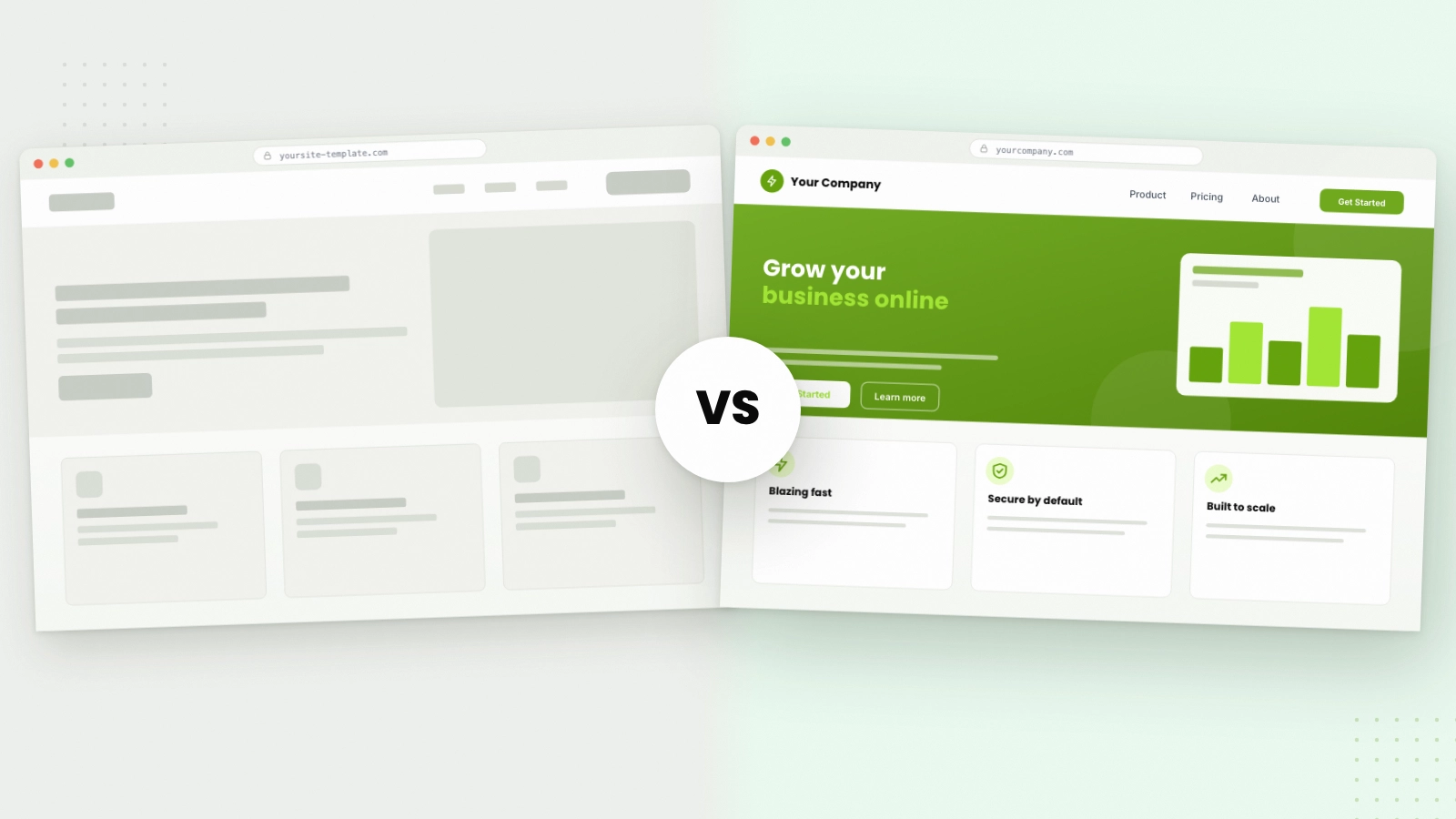
When a business in Bangladesh decides it needs a new website, one of the first questions is whether to use a ready-made template or build a custom site. Templates look attractive and promise a quick launch. Custom websites promise a better fit but can feel like a bigger commitment.
Both approaches can work. The right choice depends on what your website needs to do, how much you expect it to grow, and how you think about cost over time. This guide compares the two across the factors that matter most.
What is a template website?
A template website uses a pre-designed theme, often on WordPress or a hosted website builder, and fills it with your content. Many businesses use the same theme with only the colours and images changed. Extra features are usually added through plugins.
What is a custom website?
A custom website is designed and developed specifically for your business. The layout, features and structure are planned around your goals, content and customers, and the code only includes what your site actually needs.
Comparing the two
Speed and performance
Templates are built to suit as many businesses as possible, so they often ship with features, scripts and styles you will never use. Add a few plugins and pages can become heavy, especially on mobile data.
A custom website only loads what it needs. That makes it easier to keep pages light and fast, which matters for visitors on their phones and for search engines that take page experience into account.
SEO and search visibility
A template site can rank on Google, but you are often limited by how the theme structures headings, content and code, and fixing technical SEO issues inside a theme can be awkward.
With a custom build, technical SEO is part of the plan from day one: clean URLs, a proper heading structure, meta titles and descriptions, sitemaps, optimised images and well-structured content. If you want to appear for searches such as "diagnostic centre in Dhaka" or "furniture shop in Chattogram", a solid technical foundation helps your content do its job.
Design and brand identity
Templates can look polished, but other businesses may be using the very same design. Pushing a template beyond its intended layout often leads to inconsistent pages.
A custom design reflects your brand, your audience and your content. It can match your logo, printed material and signage, so your business looks the same everywhere people meet it.
Ownership and control
With some hosted website builders you never fully control the platform, and moving away later can be difficult. Premium themes and plugins may also come with licences that need renewing.
With a custom website, ownership terms are agreed up front in your contract and the site can be hosted where you choose. The admin panel can be designed around exactly the content your team updates.
Scalability
A template works well until you need something it was not designed for: a booking system, a customer portal, a link to your inventory, or a local payment gateway such as bKash. Then the plugins and workarounds start to pile up.
A custom website, especially one built on a framework such as Laravel, can grow with your business. New features become part of the same codebase instead of being bolted on.
Security and maintenance
Popular themes and plugins are common targets for attacks, and every plugin needs regular updates. A custom site has fewer third-party parts to look after, although it still needs good hosting, updates and backups.
Cost over time
Templates usually cost less up front. Over a few years, though, the total can include:
- Premium theme and plugin licences and renewals
- Developer time to customise or fix the theme
- Workarounds when the template cannot do what you need
- A full redesign once the business outgrows the template
A custom website usually needs a larger initial investment, but it is built around your requirements and can be extended rather than replaced. For many growing businesses, that makes long-term costs more predictable.
Quick comparison
| Factor | Template website | Custom website |
|---|---|---|
| Launch speed | Usually faster | Depends on scope |
| Upfront cost | Lower | Higher |
| Design | Shared with other sites | Built for your brand |
| Page weight | Often heavier | Only what you need |
| Technical SEO | Limited by the theme | Planned from the start |
| New features | Plugins and workarounds | Built into the codebase |
| Long-term cost | Licences and rework add up | More predictable as you grow |
Which one should you choose?
A template may be enough if:
- You need a small, simple site quickly
- Your budget is very limited for now
- You do not expect to add complex features
A custom website is likely the better fit if:
- Your website is a key source of enquiries or sales
- You want to stand apart from competitors
- You need specific features, integrations or an admin panel for your team
- You plan to grow the site over the next few years
- Search visibility matters to your business
Questions to ask any web developer
- Will the design be created for us, or adapted from a theme?
- Who owns the code, the domain and the hosting account?
- How will we update content ourselves?
- Which technical SEO work is included?
- What support is available after launch?
Build your custom website with Minus Point
Minus Point designs and develops custom websites for businesses and institutions across Bangladesh: business sites, e-commerce stores, landing pages, hospital and school websites, and Laravel-powered platforms. Every build is responsive, focused on speed and technical SEO, and comes with an admin panel your team can use.
Explore our custom web design and development service, or tell us about your project and we'll suggest the right approach. If your website needs to connect with your business systems, our custom software team can help as well.